

On great powers, bully mentality, and a world order without adults in the room
The United States condemns China.
China condemns the United States.
Russia condemns the United States.
The United States condemns Russia.
The EU condemns everyone.
Everyone condemns everyone.
And while condemnations bounce between press rooms and podiums, the world keeps burning. Wars rage. Borders shift. People die. Democracies crack. Fear grows.
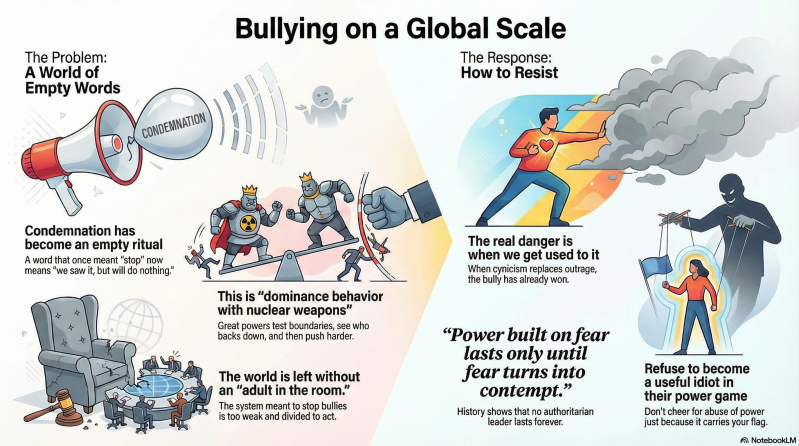
What was once meant to be morality’s strongest weapon – condemnation – has turned into an empty ritual. An echo without force. A word that once meant “stop” now mostly means: “We saw it, but we will do nothing.”
We live in the age of condemnation.
And it is a dangerous age.

When words lose their weight
After World War II, a world order was built on a simple idea:
Never again. Never again should strong nations be allowed to crush weaker ones without consequences.
The UN was created.
International law was formulated.
Principles of territorial integrity, self-determination, and human rights were established.
It was humanity’s attempt to put a floor under the worst instincts of power.
Today, that floor feels rotten.
When great powers condemn each other endlessly without anything changing, words lose their force. When every violation is met with yet another “we strongly condemn” and nothing follows, language becomes theater.
This is no longer diplomacy.
It is moral PR.
The bully’s logic – on a global scale
Look at the pattern, not the flags.
Putin pushes into Ukraine.
Xi threatens Taiwan.
The U.S. talks about Greenland, Venezuela, Colombia – in a tone that smells more of imperial reflex than responsibility.
Different cultures, different ideologies – the same psychology:
the logic of the bully.
The bully tests boundaries.
Sees who backs down.
Pushes harder next time.
Blames everything on security, history, or “the will of the people.”
On the schoolyard, we teach children to stand up to bullying.
On the global stage, we have built a system where bullies are often rewarded – as long as they are strong enough.
That is why it feels so familiar.
This is not advanced geopolitics.
This is dominance behavior with nuclear weapons.
The theater of condemnation
Every great power plays the same script:
When you do it, it’s aggression.
When we do it, it’s defense.
When you break the rules, it’s a scandal.
When we do it, it’s necessary.
Morality has become a rhetorical resource, not a compass.
A tool to win opinion, not to stop violence.
And the audience – us – is beginning to see through it.
When everyone shouts “scandal” all the time, the word loses meaning.
When everyone accuses, there is no judge left.
A world without adults in the room
What makes the situation so disturbing is not only the conflicts themselves.
It is the feeling that no one any longer has the authority to stop the powerful.
The UN was meant to be the adult in the room.
Today it often feels like a student council – well-intentioned, loud, but powerless when the toughest kids take over the playground.
We have:
-
Nuclear weapons without real global control.
-
Economic power without moral governance.
-
Information flows without shared truth.
-
Leaders without real accountability.
And we call it world order.
Why is this happening now?
Because the world is tired. Divided. Cynical.
Democracies fight themselves.
Institutions lose trust.
People feel abandoned.
Economic gaps grow.
In such times, the “strong men” step forward and say:
“I will protect you. Follow me.”
And suddenly we no longer have statesmen –
we have alpha males with nuclear arsenals.
When the world gets used to it
The real danger is not that someone wants to take more land.
The real danger is that we begin to get used to it.
Another war.
Another threat.
Another condemnation.
When the abnormal becomes normal, the bully has already won.
When cynicism replaces outrage, we stop reacting.
And power loves a tired resistance.
The high price of hypocrisy
Every great power accuses the others of hypocrisy.
And all of them are right.
The U.S. speaks of democracy but has supported dictators when it suited its interests.
China speaks of sovereignty but crushes it in Hong Kong.
Russia speaks of security while waging war on its neighbors.
The EU speaks of human rights while happily trading with regimes that despise them.
No one has clean hands.
But some have bloodier ones than others.
The problem is not that the world is full of sinners.
The problem is that no one admits their sins anymore.
Everyone points. No one reflects.
When condemnation replaces action
Condemnations should be the beginning of action.
Today they are often the end of the line.
We condemn.
We make speeches.
We tweet.
We publish press releases.
And then we move on to the next crisis.
That is not responsibility.
That is symbolic politics on steroids.
Who gave them the right?
So let us ask the question plainly, without diplomatic language:
Who the hell gave them the right to the world?
No one did.
They took it.
And they could take it because the system that was meant to stop them is too weak, too divided, and too dependent on the very powers it should restrain.
This is no longer a world order.
It is a power vacuum filled with oversized egos.
But history whispers something else
Everyone who believes they own the world makes the same mistake:
They think fear is eternal.
It is not.
History is full of emperors, dictators, and presidents who believed they stood above law, above morality, above time.
None of them did for long.
Power built on fear lasts only until fear turns into contempt.
And that moment always comes.
What remains for the rest of us?
Those of us who do not sit in bunkers, palaces, or the White House.
Those who do not command armies but live with the consequences.
We still have a choice – even when the powerful act as if they do not.
We can:
-
Refuse to buy their stories about “our side” always being right.
-
Refuse to cheer for abuse of power just because it carries our flag.
-
Dare to say:
No. You are not better just because you happen to be on my side.
That is what frightens power the most.
Not sanctions.
Not condemnations.
But people who refuse to become useful idiots in someone else’s power game.
The brutal conclusion
When great powers condemn each other endlessly and nothing changes, it means only one thing:
Words are exhausted. The system is hollowed out.
And when words no longer work, action takes over.
Unfortunately, in this world, action too often means violence.
That is why it must be said out loud:
This is not about security policy.
Not about history.
Not about strategic interests.
This is about abuse of power in its purest form.
It is not leadership.
It is not responsibility.
It is not statesmanship.
It is bullying on a global scale.
The only difference is that this time the entire world stands on the schoolyard –
and there are no teachers left who dare to blow the whistle.

By Chris...
Add comment
Comments