

The political conversation has never been louder – and perhaps never emptier.
Never before have we had so many debates, so many posts, so many opinions. And yet, rarely have so many people felt that politics no longer speaks to them.
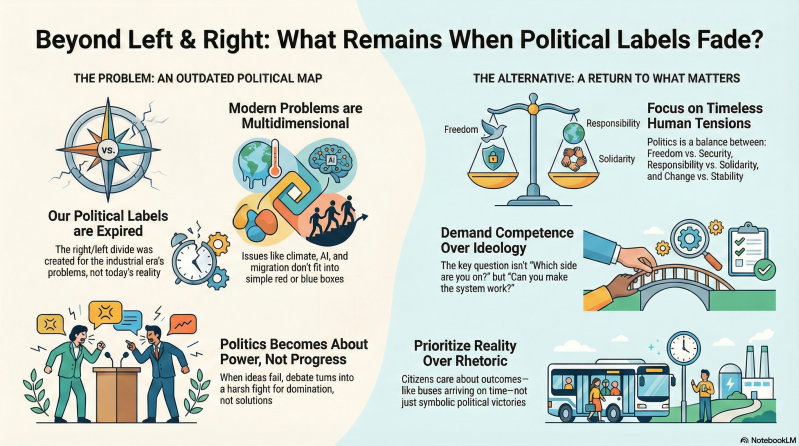
Maybe it is because we are still playing a game with rules written for another era. Right and left. Red and blue. State and market. Collective and individual. A world divided into two camps – even though reality has long since become multidimensional.
So let us try a thought experiment.
Not to be radical. Not to provoke.
But to understand.
What happens if we remove right and left?
What remains of politics when the colors fade?
When the Map No Longer Matches the Terrain
Right and left did not arise by accident. They were answers to their time. Industrialization created enormous gaps, new power structures, new social tensions. People needed orientation. Ideologies became maps in a new world.
But every map has an expiration date.

Today we live in a society where problems no longer follow straight lines. Climate is at once economic, social, and geopolitical. Migration is humanitarian, demographic, and security-related. AI is simultaneously a tool for liberation and a threat to the labor market. Everything is connected – yet debate often pretends it is not.
When we continue to interpret this complexity through a two-colored lens, politics is not just simplified. It becomes distorted.
And this is where the need for a new reflection arises:
Perhaps society has not become harder to govern.
Perhaps our concepts have simply become too small.
What Remains When Ideologies Fall Away?
When right and left are removed, something strange happens. At first there is a void. As if the ground beneath our feet has been pulled away. We miss our positions, our reflexes, our ready-made answers.
But after a moment, something else appears.
Three ancient tensions that have always existed – long before parties and programs.
Freedom and security
Human beings want to be free, but they do not want to be abandoned.
We want to make our own choices, but we do not want to stand alone when we fail. This conflict has followed us from antiquity to the welfare state. Right and left have simply given different names to the same dilemma.
Responsibility and solidarity
When is something my problem – and when does it become ours?
In small communities the answer was obvious. In large systems it becomes blurred. Solidarity is institutionalized, while responsibility becomes anonymous. The result is constant friction between calls for community and demands for independence.
Change and stability
Everyone wants development. No one wants chaos.
Everyone wants security. No one wants stagnation.
This is not a battle between ideologies. It is a battle between tempo and patience.
When we stop calling these tensions right and left, we see them for what they are: human conditions.
Power – The Only Ideology That Always Survives
When the colors fade, one thing becomes clearer than everything else:
Politics is, at its core, always about power.
Who decides?
Who sets the framework?
Who owns the narrative?
Right and left have often been presented as moral opposites, but in practice they frequently function as different languages for the same struggle: the struggle for interpretive authority. Whoever defines the problem also controls the solution.
And perhaps that is why the debate has become so harsh. When ideologies lose their explanatory power, power itself becomes the last fixed point. The tone hardens, positions become absolute, rhetoric turns sharper – not to persuade, but to dominate.
When Ideologies Fall Silent, Competence Speaks
In a society without right and left, it becomes harder to hide behind words. A more uncomfortable question emerges:
Can you actually do this – or can you not?
Many of our greatest social problems are not ideological.
They are organizational.
Crises in healthcare rarely come down to political color – they come down to leadership, governance, and priorities. Problems in education have less to do with ideological direction and more with long-term system design. Infrastructure projects fail not because the wrong values were chosen, but because responsibility dissolves in layers of bureaucracy.
When right and left disappear, politics is forced to become concrete.
Painfully concrete, some would say.
But also necessarily so.
Suddenly it is no longer about who won the debate – but about who makes the systems work.
The Forgotten Main Character: The Human Being
In ideological trench warfare, the citizen often becomes a side character. An argument. A statistic. An example.
But when we strip away right and left, a different picture emerges.
Ordinary people do not primarily care about ideology.
They care about outcomes.
Whether the bus arrives on time.
Whether the clinic answers the phone.
Whether the pension covers the rent.
Whether children get a fair start in life.
This is where today’s greatest political gap appears:
between symbolic politics and everyday reality.
The more debate revolves around identity and positioning, the less it revolves around function. And the less it revolves around function, the more people feel that politics no longer concerns them.
A Colorless Society – Empty or Mature?
To remove right and left may sound like draining politics of meaning. But perhaps the opposite is true. Perhaps that is when meaning finally becomes visible.
Values do not disappear when ideologies fall silent.
They simply become harder to hide behind labels.
Justice, freedom, dignity, responsibility – all remain.
But now they must be translated into action rather than slogans.
And perhaps that is what truly frightens us. Because it is easier to win a debate than to build a functioning system. Easier to point at an opponent than to take responsibility for the whole. Easier to claim righteousness than to practice it.
Politics for a More Complex Time
We no longer live in a world where society’s direction can be determined by two axes. Our era demands something else: the ability to hold multiple perspectives at once. To accept that no side owns the truth. To understand that solutions often lie between – or beyond – old oppositions.
Perhaps the next step in political evolution is not to create new ideologies, but to grow beyond the need for them. To build a public conversation where the first question is not where you stand, but what you see. Where people are not instantly placed into camps, but listened to through experience. Where victory is not the goal – direction is.
Final Words: From Position to Responsibility
When right and left fall silent, something else becomes audible.
The pulse of society.
The need for stability in a moving world.
The longing for leadership that does not shout – but understands.
Perhaps politics once began right there:
in the shared responsibility for our shared life.
And perhaps, after all its detours through ideological landscapes, it is slowly finding its way back.
Not to the right.
Not to the left.
But to responsibility for the whole.

By Chris...
Add comment
Comments