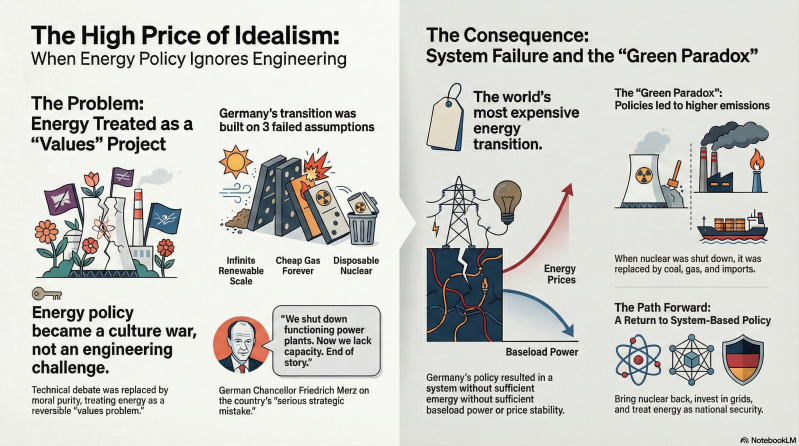
When German Chancellor Friedrich Merz openly admits that abandoning nuclear power was a “serious strategic mistake,” something rare happens in politics: reality catches up with the narrative. Not through a white paper. Not through an expert panel. But through a blunt statement of the obvious. We shut down functioning power plants. Now we lack capacity. End of story.
It’s late. But it’s honest.
The problem is that Germany is not alone. What Merz is now saying out loud is something many Western governments have already learned in silence: energy is not an arena for symbolic politics. It does not care about narratives, hashtags, or moral posturing. It cares about three things only – capacity, stability, and price. Fail on one, and you are punished. Fail on all three, and you get exactly what Germany has today: the world’s most expensive energy transition and a growing deficit in actual power generation.

The big mistake was not wanting to transition
The big mistake was how it was done.
Germany built its Energiewende on three assumptions that turned out to be political wishful thinking rather than technical reality.
First: that renewables could scale faster than grids, storage, and balancing power allow.
Second: that gas would remain cheap, stable, and geopolitically neutral.
Third: that nuclear could be removed without the system losing its backbone.
All three collapsed – at the same time.
The result is an energy system without sufficient baseload, without price stability, and without strategic autonomy. That is not a green revolution. That is a managed shortage.
And the greatest irony? The country that engineered some of the world’s safest nuclear plants shut them down – then burned more coal, imported more gas, and watched industry move abroad.
This is not climate leadership. This is energy policy run like a culture war.
When morality overtakes technology
The real error was not in aiming to become fossil-free. The error was turning energy policy into an identity project.
When nuclear power in Germany became a symbol of everything “old,” “dangerous,” and “wrong,” the technical debate vanished. What remained was moral purity. Being anti-nuclear became a way to signal that you stood on the “right side” – not that you had the right solution.
Energy stopped being a systems problem. It became a values problem.
And this is where history repeats itself – country after country.
Sweden: world-class at shooting itself in the foot
Sweden did the same, though more quietly. When fully functioning reactors were shut down early, it wasn’t because they were unsafe or obsolete – but because they were politically inconvenient. The result has been a more fragile power system, sharply rising prices in southern Sweden, and an industry now hesitant about electrification promises.
We talk about fossil-free steel, battery factories, electrified transport – but we dismantled the stable foundation that was supposed to carry it all. It’s like building a skyscraper after selling the steel reinforcements.
Belgium: shut down first, think later
Belgium is an even clearer example. There, nuclear phase-out was pushed through despite repeated warnings about capacity shortages. The result? Panic extensions, last-minute gas dependence, and an energy system living on exemptions. Politics made the decision first – engineers were left to clean up the consequences.
Spain: sun without shade
Spain is often praised as a renewable role model. And yes, it has built impressive solar and wind capacity. But without sufficient balancing power and storage, it has repeatedly been forced into emergency solutions when weather dependency fails. When the sun doesn’t shine and the wind doesn’t blow, no vision helps. Only available power does.
California: green dreams, dark evenings
California may be the clearest example of what happens when political goals outrun system understanding. The state shut down nuclear power, restricted gas, and simultaneously pushed rapid electrification. The result has been rolling blackouts, extreme prices, and a grid unable to carry its own ambition.
It has the world’s most progressive climate rhetoric – and one of the most unstable energy systems in practice.
France: the opposite that worked
Then there is France. It did the opposite. It built an energy system based on nuclear power, long-term planning, and technical rationality. The result was decades of low electricity prices, low emissions, and high energy security.
Yes, France has had problems too – but theirs were technical and temporary, not ideological and permanent.
The difference is simple: in France, energy was infrastructure. In Germany, energy became identity.
The dangerous confusion
When Merz now says Germany should have kept nuclear power, it is not really a technical analysis. It is an admission of a political system failure: symbols were allowed to govern where system requirements should have ruled.
Energy is not a debate topic. It is a nervous system. You cannot experiment with a nervous system without the body reacting.
Yet that is exactly what many countries did. They treated energy policy as if it were migration policy, culture policy, or education policy – something you can reverse every four years. In reality, energy systems demand decades of continuity.
That is why the consequences are now so brutal.
The green paradox
Here lies the great irony: many of the decisions made in the name of the climate have led to higher emissions, not lower.
When nuclear is shut down early, it is not replaced by ideals – but by coal, gas, and imports. When stable baseload disappears, the dirtiest solutions become the backup.
That is why Germany increased coal use after its nuclear phase-out. That is why Belgium extended old reactors in panic. That is why California fires up gas turbines during heatwaves.
Green politics turned out browner than the old system.
Merz says what everyone knows – but few dare to say
When Merz now states that Germany lacks generation capacity, it is not ideological retreat. It is an accounting. And it should echo far beyond Germany’s borders.
The same conversation should be happening in Stockholm, Brussels, Madrid, Sacramento – and Brussels again – because the EU as a whole is walking into the same trap: high targets, weak system design.
The real threat to the climate transition is not climate denialists. It is system denialists – politicians who refuse to accept that energy follows physics, not opinion polls.
The road ahead requires something rare in politics: humility
If there is one lesson from Germany’s energy journey, it is this: you cannot moralize away megawatts.
Future energy policy must stop being about signaling the right values and start being about building the right systems. That means:
bringing nuclear back as a serious part of the solution
investing in grids and storage before shutting down stable generation
stopping the pretense that weather-dependent power can carry an industrial society alone
treating energy as security policy, not a PR campaign
It’s not popular. It’s not romantic. But it’s grown-up.
Finally
When the history of the green transition is written, Germany’s nuclear phase-out will not be described as courageous. It will be described as an example of what happens when morality replaces engineering.
Merz’s admission is late – but important. The only question is whether the world dares to draw the conclusion in time.
Because energy does not wait for our stories.
It only responds to our systems.
And right now, it is responding with the world’s most expensive electricity bill.

By Chris...