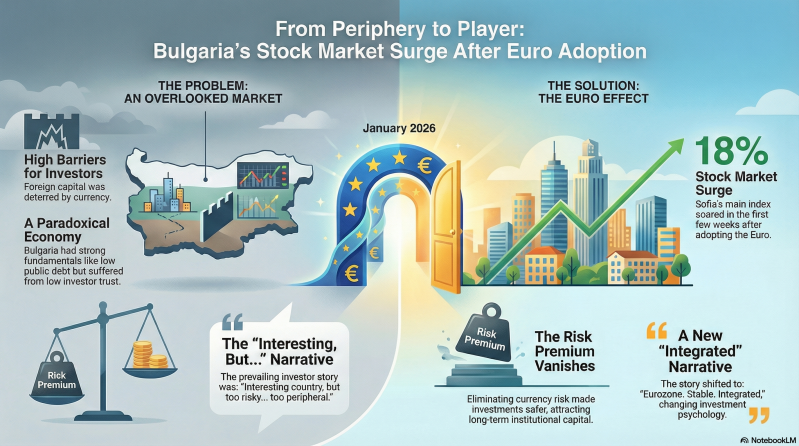
When Bulgaria entered the eurozone at the turn of 2026, it was more than a technical monetary step. It marked a psychological, political, and economic turning point. Within just a few weeks, the effects became clearly visible in the place where markets often react faster than politics: the stock exchange. Sofia’s main index has risen by around 18 percent since New Year, placing Bulgaria among the strongest-performing stock markets in the world so far this year.
But what is really happening? Is this just a temporary wave of enthusiasm, or the beginning of a deeper structural shift?

A historic step for a young market economy
For a long time, Bulgaria has been a paradox on Europe’s economic map. The country has low public debt, a stable currency framework, and relatively sound public finances – yet at the same time struggles with low trust, a weak capital-market system, and limited international attention.
The lev had already been pegged to the euro under the currency board, but formally joining the eurozone is something entirely different from living in its shadow. It means:
-
full participation in the ECB system
-
greater transparency in financial flows
-
easier movement of capital
-
and above all: psychological confirmation of belonging
For international investors, this is often more important than the technicalities of the currency itself. Euro adoption signals that Bulgaria is no longer just a peripheral growth market in the Balkans, but an integrated part of Europe’s economic core.
The market reaction – more than just numbers
When the SOFIX index rises by almost 20 percent in just a few weeks, it is tempting to think in short-term headlines: “euphoria,” “overreaction,” “speculative bubble.”
But a closer look reveals a pattern seen in other countries that have taken the same step. Slovakia, Slovenia, and the Baltic states all experienced similar stock-market rallies after joining the euro – not necessarily because companies suddenly became better, but because the risk premium declined.
When currency risk disappears from the equation, something fundamental happens:
-
required returns fall
-
capital flows become more long-term
-
pension funds and institutional investors dare to step in
-
companies gain access to cheaper financing
This is not speculation – it is mathematics.
From isolated market to European player
For decades, the Sofia Stock Exchange has suffered from low liquidity. Many companies have been undervalued, not because they lack potential, but because they were difficult to access. Foreign investors hesitated due to:
-
legal uncertainty
-
currency risk
-
political instability
-
lack of coverage and transparency
Euro adoption does not solve all of these issues, but it lowers the barrier. And in capital markets, barriers often determine whether money moves or not.
Suddenly, Bulgaria is no longer an exotic special case – but part of the same system as Germany, France, and the Netherlands.
Banks at the center of the revaluation
It is no coincidence that the financial sector is among the biggest winners of the rally. Bulgarian banks enter the eurozone with relatively strong balance sheets, high capital adequacy, and limited exposure to risky assets.
With the euro, they gain:
-
access to ECB liquidity mechanisms
-
lower funding costs
-
stronger international credibility
-
opportunities to expand regionally
For investors, this means banks once seen as purely local players now appear as regional actors in Southeastern Europe.
It is a classic transition: from survival banking to growth banking.
Real estate, infrastructure, and industry
Another sector benefiting from the shift is real estate and infrastructure. As capital becomes cheaper and risk declines, investment increases in:
-
housing
-
commercial property
-
logistics
-
transport
-
energy
At the same time, industrial companies gain from the disappearance of currency costs and exchange-rate risks. For exporters, this means more predictable cash flows. For international partnerships, simpler pricing and fewer contractual obstacles.
It may sound technical – but these details decide whether Bulgaria is perceived as a temporary low-cost market or as a long-term industrial base.
The psychology behind the rally
Stock markets are not driven only by profits and balance sheets. They are driven by narratives. And euro adoption changes Bulgaria’s story.
Previously, the narrative often sounded like this:
“Interesting country, but…”
“…but too risky.”
“…but too complicated.”
“…but too peripheral.”
Now a new story is taking shape:
“EU country.”
“Eurozone.”
“Stable.”
“Integrated.”
This is not propaganda – it is investment psychology.
When a market changes identity, revaluations happen long before corporate results actually change.
The risk of a setback
Of course, risks remain. Any rally can be followed by a correction. Some factors that could create headwinds include:
-
political turbulence
-
weak reform of the judicial system
-
slow bureaucracy
-
renewed focus on corruption issues
The euro alone does not solve structural problems. It can even expose them more quickly, as demands for transparency and stability rise.
But there is a crucial difference: Bulgaria is now under a stronger international spotlight. And it is often this exposure that drives real change.
From survival economy to investment logic
For a long time, much of Bulgaria’s economy has been shaped by a survival mindset. Companies have been cautious. Investments postponed. Many have focused more on minimizing risk than on expanding.
Euro adoption can mark the beginning of a mental shift:
-
from defensive to offensive strategies
-
from short-term thinking to long-term planning
-
from local markets to regional ambition
This is the real meaning of the stock-market surge. Not the numbers themselves – but the change in self-perception.
What does this mean for ordinary Bulgarians?
Here the picture becomes more complex. A rising stock market does not automatically benefit everyone. There are risks that:
-
housing prices rise faster than wages
-
capital becomes concentrated among already strong groups
-
gaps between cities and rural areas widen
But there are also major opportunities:
-
more jobs in finance, tech, and services
-
stronger international presence
-
greater mobility in the labor market
-
better financing for small and medium-sized enterprises
The key will be policy. If euro adoption is used as a catalyst for reform, education, and entrepreneurship, the stock-market rally could mark the beginning of broader prosperity. If not, it risks remaining an elite project.
A symbolic turning point for the entire region
Bulgaria is not alone. The Balkan region has long been seen as Europe’s backyard – politically complex, economically fragmented, and institutionally weak.
But Sofia’s stock-market performance sends a signal far beyond Bulgaria’s borders:
Narratives can change.
Countries can step into the center.
It is possible to move from the periphery to the core.
For Romania, Serbia, North Macedonia, and others in the region, this is an example of how quickly perception can shift when structural decisions are made.
The beginning of a new era?
Looking back in ten years, 2026 may not only be remembered as the year Bulgaria changed its currency – but as the year it changed its self-image.
The surge on the Sofia Stock Exchange is not just a market phenomenon. It is a sign that:
-
Bulgaria is being seen anew
-
Bulgaria is being valued anew
-
Bulgaria is being interpreted anew
From a country long associated with “cheap” and “risky” – to one increasingly associated with “opportunity” and “potential.”
And in the end, that may be the most important currency of all.

By Chris...