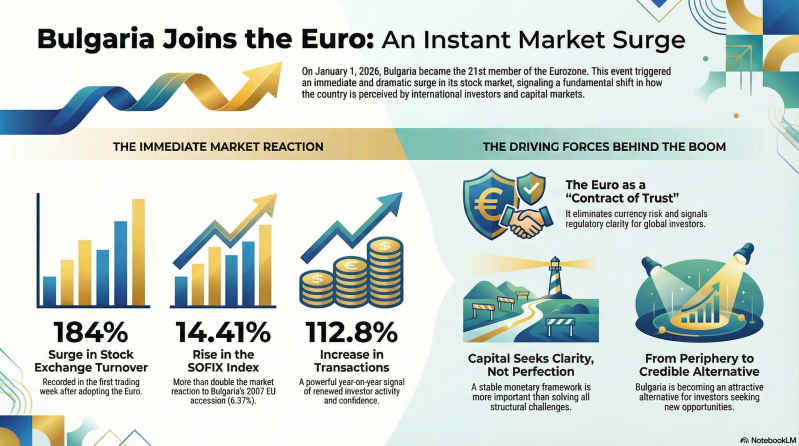
When Bulgaria became the 21st member of the euro area on January 1, 2026, it was not merely a symbolic milestone in the country’s modern history. It also marked the starting point of a clear and measurable shift in how the country is perceived by investors, capital markets, and international stakeholders. Already in the first trading week after the euro’s adoption, turnover on the Bulgarian Stock Exchange surged by an extraordinary 184 percent. At the same time, the number of transactions increased by 112.79 percent year-on-year.
These are not marginal movements. They are powerful signals—and difficult to misinterpret.

A Stock Market Awakens – Fast
The country’s oldest and most established market indicator, SOFIX, rose by 14.41 percent during the very first trading week after the euro transition, reaching 1,323.06 points. On the first trading day alone, the index jumped 3.7 percent, a pace that then continued steadily in the days that followed.
In a European context—where markets often move cautiously and in small increments—this is an exceptionally strong reaction. It reflects not short-term speculation, but rather accumulated confidence finally being released.
Historical Parallels – EU Accession as a Reference Point
The exchange itself draws parallels with another decisive moment in Bulgaria’s history: accession to the European Union in 2007. Back then, the market also experienced a clear upswing in activity. In the first trading week after EU accession, SOFIX rose by 6.37 percent—from 1,224.12 to 1,302.81 points.
The difference this time, however, is striking. The reaction in 2026 is more than twice as strong. That says a great deal about both the current context and Bulgaria’s changed position. The country is no longer a peripheral EU member that has “just joined.” It is now a euro-area country, fully integrated into Europe’s monetary core.
The Euro as a Psychological Threshold
Associate Professor and Executive Director of the exchange, Manyu Moravenov, describes euro adoption as a repositioning of Bulgaria on Europe’s financial map. This statement matters because it points to a frequently underestimated factor: psychology.
The euro is more than a currency. It is a contract of trust.
For international investors, the euro area means:
-
no currency-hedging risk against the lev or other local currencies
-
clearer regulatory frameworks and comparability
-
greater liquidity and institutional security
When these barriers disappear, something often happens—especially in markets that have long been undervalued.
Capital Seeks Clarity, Not Perfection
What is particularly interesting is that this development occurs despite Bulgaria still facing well-known structural challenges: demographics, bureaucracy, regional disparities, and at times fragile trust in institutions. But capital does not seek perfect societies. Capital seeks clarity.
Euro adoption delivers exactly that:
-
clear rules of the game
-
predictability
-
a stable monetary framework
For markets, that is often more than enough.
A Receipt for Years of Quiet Work
The sharp rise in market activity is not an isolated miracle that appeared overnight. Rather, it is a receipt for years of work behind the scenes: companies becoming more transparent, improved corporate governance, rising financial literacy, and growing interest in capital markets among Bulgarian firms.
Moravenov points out that the current growth cycle for publicly listed companies is likely to continue for at least the next two years. This is a forecast based not on optimism alone, but on structure.
From Peripheral Market to Credible Alternative
At a time when many Western European stock exchanges are perceived as saturated, expensive, and heavily analyzed, smaller markets are beginning to play a new role. Bulgaria is moving from being a peripheral market to becoming an alternative.
An alternative for:
-
long-term institutional investors
-
regional investment funds
-
companies seeking capital in an environment where they can still stand out
It is often during these phases that the most interesting valuations emerge.
Sofia – More Than an Administrative Capital
The surge on the stock exchange also reflects something broader happening in Sofia and across the country. The city is transitioning from an administrative capital into a regional financial hub. The IT sector is expanding, international companies are establishing operations, and more entrepreneurs are beginning to view Bulgaria as a base rather than a backwater.
In this context, the stock exchange becomes not just a trading venue, but an expression of confidence.
Risks Remain – But They Are Known
Of course, risks remain. Rapid growth can attract short-term capital. Liquidity can become unevenly distributed. Small markets are always sensitive to external shocks. The difference now is that Bulgaria enters the euro area with open eyes and experience.
This is not a first step into the dark. It is a step into a room the country has been observing for a long time.
A Moment That May Define a Decade
It is rare to be able to point to a specific week and say: this is when it happened. But January 2026 may well become such a moment for Bulgaria. Not because all problems were solved, but because the direction became clear.
The market reacted. Capital responded. And the verdict was delivered swiftly.
It was not a hesitant maybe.
It was a resounding yes.
And sometimes, that is exactly what is required for a country to take its next step—not only economically, but mentally.

By Chris...