When a stock market rises sharply, the market applauds. Politicians smile. Headlines are written. But history teaches us one thing: a strong stock market is never an end goal – it is an opportunity.
Bulgaria now finds itself in precisely such a moment. Capital is flowing into the country. Trading volumes are increasing. International attention is turning toward Sofia. This is momentum many countries only dream of. The question is not whether this matters – but how this momentum should be used.
Because this is where nations that build lasting prosperity are separated from those that merely ride temporary waves.

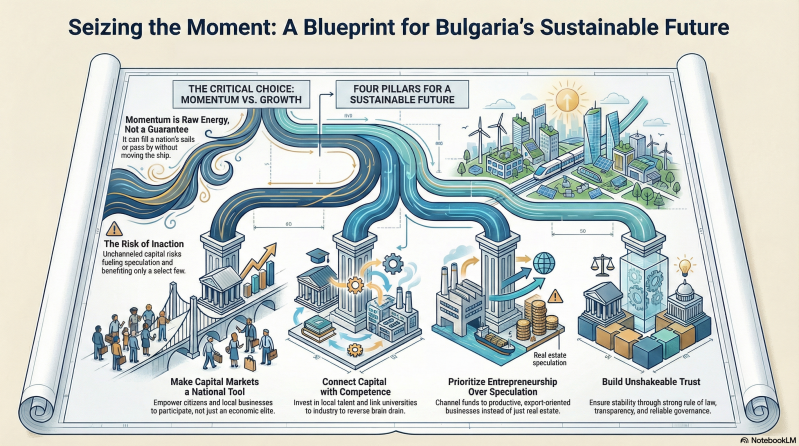
Momentum Is Not Growth – It Is Raw Energy
Momentum is like wind. It can fill the sails – or pass by without moving the ship.
If capital inflows are not properly directed, they risk:
-
fueling speculation instead of productivity
-
benefiting a few rather than society
-
creating growth without stability
Sustainable development requires structure. And structure requires
political understanding of systems, not just isolated numbers.
Step One: Turn the Stock Market into a National Tool – Not an Elite Playground
In many countries, the stock market is perceived as something that belongs to:
-
banks
-
investors
-
an economic elite
This is a fundamental mistake.
A healthy capital market should:
-
provide local companies with access to growth capital
-
offer ordinary citizens a way to save and invest
-
function as a bridge between ideas and expansion
This requires political decisions that:
-
simplify listing processes for small and medium-sized enterprises
-
lower the barriers for broad public ownership
-
encourage long-term savings rather than short-term trading
When people own a part of the future, their relationship with society changes.
Step Two: Connect Capital Markets with Education and Skills
Capital without competence leads to stagnation.
Competence without capital leads to emigration.
Bulgaria faces a well-known challenge: young, talented people leave the country.
Used correctly, a strong stock market can become part of the solution.
This requires:
-
stronger links between universities, research, and industry
-
incentives for companies to invest in local talent
-
public support for innovation clusters, not just industrial zones
Capital should not only seek returns – it should build people.
Step Three: From Real Estate to Entrepreneurship
When capital flows into a country, it often goes where it is easiest:
-
real estate
-
short-term speculation
-
import-driven consumption
This creates the illusion of growth, but few future-proof jobs.
A sustainable country instead channels capital toward:
-
productive companies
-
export-oriented businesses
-
technology, services, and creative industries
Politics must dare to guide – not through micromanagement, but through smart incentives.
Step Four: Build Long-Term Trust – Not Short-Term Popularity
Capital is sensitive. It reacts not only to numbers but to:
-
the strength of the rule of law
-
transparency
-
institutional stability
A stock market rally can quickly reverse if:
-
regulations change unpredictably
-
political conflicts block reforms
-
corruption or nepotism undermines trust
This demands political leadership that understands one crucial fact:
trust takes years to build and moments to destroy.
Step Five: Treat Citizens as Stakeholders – Not Spectators
One of the greatest mistakes countries make is allowing economic development to
become something that happens “above people’s heads.”
When citizens do not feel that:
-
their daily lives are improving
-
their children have better opportunities
-
their work is valued
distrust grows – even during periods of economic growth.
Sustainable development means:
-
jobs that pay more than subsistence wages
-
opportunities to save and build ownership
-
real social mobility
A strong stock market without social anchoring is politically explosive.
Step Six: Learn from Others – Without Blind Imitation
Small European countries have walked this path before:
-
some used capital markets to build strong export economies
-
others allowed speculation to erode their social contract
The difference has almost always been governance, not markets.
Markets do their job.
Politics must set the framework.
The Big Question: Can BULGARIA Afford to Waste This Moment?
Bulgaria has missed several opportunities in the past:
-
after EU accession
-
during the first wave of globalization
-
when low-cost labor was its main competitive advantage
Now the playing field is changing.
Work is becoming digital. Capital is mobile. Location is a choice.
A strong stock market signals that Bulgaria can be more than a low-cost country. But this requires a mental shift:
-
from administration to vision
-
from reactive politics to systems thinking
-
from short-term gains to long-term societal value
Conclusion: Momentum Is a Responsibility
A rising stock market is not a trophy on the wall.
It is an open door.
Building a sustainable country requires political leadership that:
-
understands the whole system
-
dares to prioritize the long term
-
recognizes that capital is a means, not an end
The question is not whether Bulgaria has momentum.
It does.
The question is:
Who will take responsibility for turning this moment into a future
that endures – economically, socially, and humanly?
Because history is clear:
Momentum that is not used – disappears.

By Chris...