Howard Lutnick, Davos, and the New Fault Line in the Global Economy
When Howard Lutnick, the U.S. Secretary of Commerce, takes the stage at the World Economic Forum in Davos and declares that “globalization has failed,” it is more than just another political soundbite. It is a frontal challenge to an idea that, for more than three decades, has functioned as a near-sacred foundation of the Western economic order.
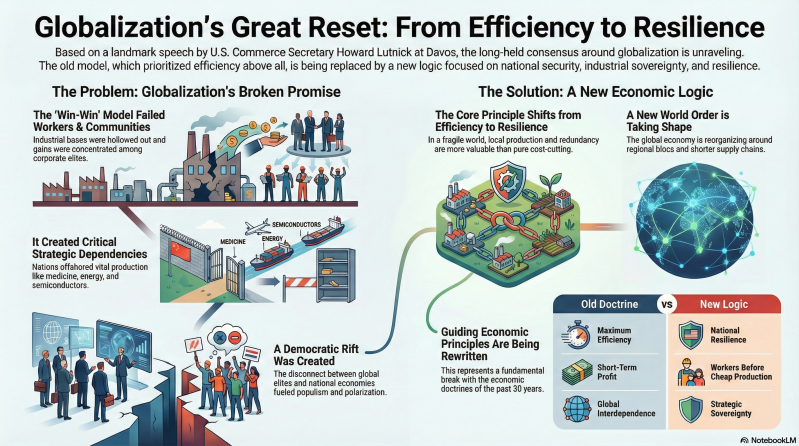
Lutnick’s message is clear, provocative—and for many, uncomfortably true: the promise of globalization has been broken. Instead of shared prosperity, industrial bases have been hollowed out, workers left behind, and nations made strategically dependent on others for things that should lie at the very heart of sovereignty.
This is no longer an academic debate. It is a question of security, democracy, and future freedom of action.

The Promise of Globalization—and Its Price
Throughout the 1990s and 2000s, globalization was sold as a win-win model. Production would move to where labor was cheapest, goods would become more affordable, growth would accelerate, and a more interconnected world would become more peaceful.
In theory.
In practice, vast parts of the Western industrial base were offshored. Factories closed, entire regions lost their economic backbone, and stable jobs were replaced by precarious service work. The gains were concentrated among multinational corporations and shareholders, while the costs were borne by local communities.
Markets did not fail—politics failed to confront the consequences.
America First—but the Logic Is Global
When Lutnick speaks of America First, he does more than revive a slogan associated with the Trump administration. He outlines an alternative economic logic:
-
Workers before the cheapest possible production
-
Sovereignty before maximum efficiency
-
Resilience before short-term profit
This represents a fundamental break with the doctrine that has shaped Washington, Brussels, and Davos for decades.
Ironically, it is a logic that many countries—Europe included—have already begun to adopt in practice, even if they hesitate to acknowledge it openly.
Sovereignty Is Not Nationalism—It Is Responsibility
One of Lutnick’s strongest arguments concerns what nations should not offshore: medicine, semiconductors, energy, food, and core industrial capacity.
The pandemic brutally exposed what happens when pharmaceutical production sits on the other side of the world. Supply chains collapsed, protective equipment became a geopolitical bargaining chip, and countries literally competed against one another.
The semiconductor shortage did the same to the automotive and technology sectors.
This is not about isolationism. It is about recognizing that certain functions are so fundamental that they cannot be left entirely to “the market.”
Europe’s Strategic Own Goal: Net Zero Without Industry
Lutnick also delivers a sharp critique of Europe’s climate strategy—not of its ambition, but of its lack of realism.
Why commit to net zero targets when Europe barely produces its own batteries? Why accept goals that, in practice, make the continent dependent on China for the most critical component of the energy transition?
This is where the green transition risks becoming a new form of economic dependence rather than a path to autonomy.
Saving the planet without building industrial capacity is not leadership—it is symbolism.
Davos: Compass or Weather Vane?
Lutnick is particularly critical of Davos as an institution. In his view, it does not function as a stable moral or economic compass, but rather as a weather vane—turning with whichever ideological wind happens to blow.
Today it is ESG. Yesterday it was free trade at any cost. Tomorrow it will be something else.
The problem is not dialogue—the problem is the absence of accountability for consequences.
Davos gathers the world’s power brokers, but all too rarely the workers, producers, and local communities affected by their decisions.
When Globalization Becomes an Elite Project
One of the most overlooked consequences of globalization’s failure is the democratic rift it has created. When political choices benefit global elites while undermining national economies, trust erodes.
It is no coincidence that populism, protectionism, and political polarization have grown alongside globalization.
People can accept change—but not being abandoned.
From Efficiency to Resilience
The most significant shift in Lutnick’s argument is the move from efficiency to resilience.
In a world marked by war, pandemics, cyber threats, and geopolitical fragmentation, the most efficient solution is often the most fragile one.
Redundancy, local production, and strategic alliances cost more—but they preserve freedom of action.
And history shows that freedom is always cheaper than dependence in the long run.
A New World Order—Whether We Like It or Not
Whether one agrees with Howard Lutnick or not, his speech points to an unavoidable reality: the old globalization model is already unraveling.
The world is moving toward:
-
Regional blocs
-
Strategic industrial policy
-
Shorter supply chains
-
National security as an economic factor
The question is not if this transition will happen—but how well it will be managed.
Final Thoughts: Restarting Globalization, Not Burying It
What Lutnick is ultimately arguing is not that cooperation is wrong, but that responsibility has been missing. Globalization without a social contract, without industrial strategy, and without democratic legitimacy cannot endure.
It does not need to be abolished—but it must be rebuilt.
With workers, communities, and sovereignty at its core.
That is an uncomfortable message in Davos.
Which may be precisely why it needed to be said.

By Chris...
'Globalization Has Failed:' Commerce Sec. Howard Lutnick Tells Attendees at World Economic Forum