Quietly, without major press conferences or exaggerated headlines, Bulgaria has launched what is, in practice, the most accessible digital nomad visa in the European Union. For anyone following Europe’s demographic shifts, economic pressures, and changes in how work is organized, this is no coincidence. It is a deliberate move within a larger strategic framework—and it deserves closer examination.
A visa that reflects how work actually looks today
Over the past decade, digital work has moved from exception to norm across many industries. The pandemic acted as an accelerator, but the trajectory was already clear. Countries that continue to shape migration and labor policies around an industrial-era model risk becoming irrelevant. Bulgaria has chosen a different path.
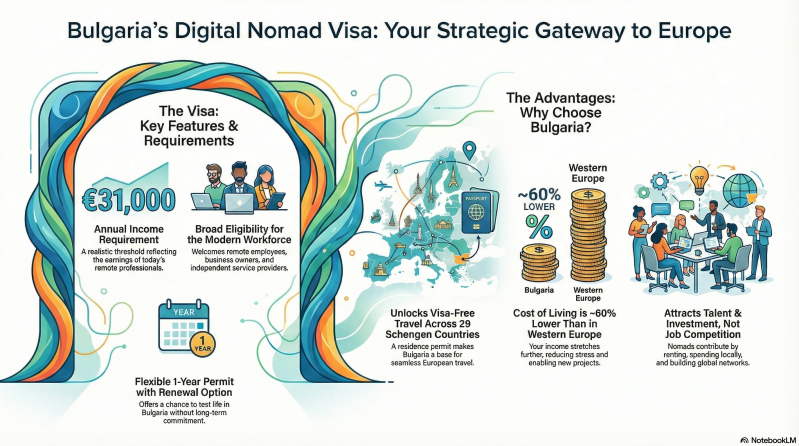
With an income requirement of €31,000 per year, roughly €2,583 per month, Bulgaria lowers the barrier to Europe to a level that reflects the reality of freelancers, consultants, remote employees, and small business owners worldwide. It is neither unrealistically low nor elitist—rather, it is calibrated to attract people who are actively working, earning, and participating in the real economy.

Schengen – the real leverage
Since March 2024, Bulgaria has been a full member of the Schengen Area. This is where the visa transforms from a national instrument into a European gateway.
A residence permit in Bulgaria now provides visa-free movement across 29 European countries. You can live in Sofia or Bansko, work for a client in the United States, travel to Berlin for meetings, Paris for inspiration, and Barcelona for networking—without having to renegotiate your status at every border.
In practical terms, Bulgaria becomes a base, not a limitation.
Three eligibility categories – broad and realistic
One of the most compelling aspects of the visa is how closely it aligns with today’s labor market. Three groups qualify:
– Employees of non-EU companies
– Business owners with at least 25% ownership
– Independent service providers with at least one year of documented remote work history
Together, these categories cover a vast share of the global digital workforce: developers, designers, marketers, journalists, analysts, producers, creatives, advisors, and consultants. It is evident that the framework was not written in a bureaucratic vacuum, but with a practical understanding of how people actually earn a living today.
One year at a time – intentional flexibility
The permit is issued for one year, with the possibility of renewal for an additional year. This is not a weakness—it is a strength.
For the individual, it offers the chance to:
-
test life in the country without long-term obligation
-
build networks gradually
-
decide whether to take the next step—company formation, permanent residence, or family relocation
For the state, it allows evaluation, control, and adaptability. Bulgaria avoids permanent commitments before understanding how the inflow functions in practice.
The option for family reunification also makes the visa attractive to established professionals, not only to young nomads in their twenties.
Cost of living – the quiet competitive advantage
That Bulgaria’s cost of living is approximately 60% lower than in Western Europe is more than a lifestyle perk. It is a structural advantage.
Lower rents, affordable transportation, reasonable food prices, and accessible services mean that:
-
income stretches further
-
stress levels drop
-
more people dare to launch independent projects
-
creative ideas are given time to mature
This creates an ecosystem where people do not merely consume, but generate long-term value.
What Bulgaria is really buying
It is easy to frame this as a “cheap visa.” In reality, Bulgaria is purchasing something far more valuable: time, competence, and global networks.
Digital nomads rarely compete directly for local jobs. Instead, they:
-
rent housing
-
spend locally
-
use services
-
share expertise
-
start companies
-
connect the country to international networks
The risk is low, the upside significant.
Part of a broader movement
The digital nomad visa should be seen alongside other parallel developments:
-
a growing tech sector
-
increasing foreign investment
-
stronger capital markets
-
euro adoption
-
rising international visibility
Together, these elements send a clear signal: Bulgaria does not merely want to be the cheapest option. It wants to be relevant.
Implications for the rest of the EU
When one EU member lowers barriers while maintaining oversight, it puts pressure on others. Countries with high income thresholds, slow processing times, and rigid bureaucracy risk losing appeal—not due to taxes, but due to inertia.
Bulgaria demonstrates that it is possible to be:
-
open
-
controlled
-
competitive
—at the same time.
Who is this visa really for?
This visa is not designed for people seeking to “escape systems.” It is designed for those who want to work, live, and contribute—but on their own terms. People who value freedom, balance, and international mobility, and who see Europe as a connected whole rather than a patchwork of isolated nation-states.
Conclusion – visas as future policy
Bulgaria’s digital nomad visa is not a marketing gimmick. It is future policy in practical form.
For individuals, it represents one of the most rational and flexible choices in Europe today.
For Bulgaria, it is a way to accelerate development without resorting to costly subsidies or symbolic politics.
It is not a revolution.
It is something more interesting.
It is a calm, carefully considered move—and precisely for that reason, it works.

By Chris...