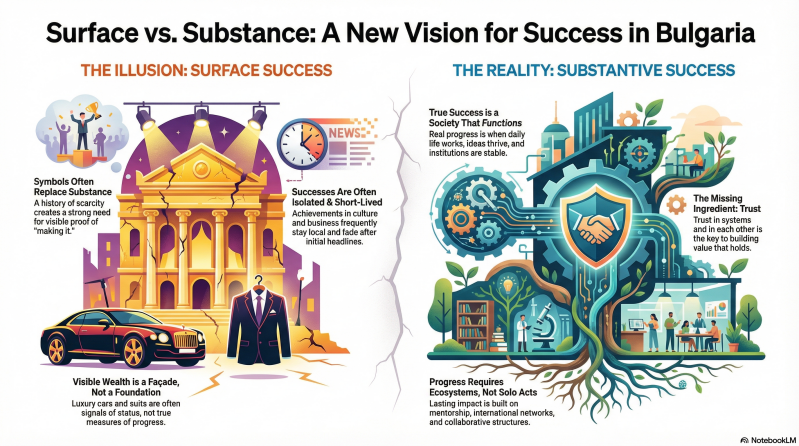
It doesn’t matter how many suits you own or how many luxury cars fill the streets of Sofia.
That is not success.
It is surface. It is signaling. Often, it is compensation.
In many cities you can walk along the main boulevards and get a sense of movement, money, momentum. Shiny cars. Tailored suits. New cafés. New offices. Everything looks like progress. But progress and success are not the same thing. Motion is not direction.
I often say: “What happens in Bulgaria stays in Bulgaria.”
Not as a joke. Not as criticism. But as an observation that keeps repeating itself.
A lot is happening here. More than many outside the country realize. Culture, entrepreneurship, ideas, people with drive and competence. Yet much of it remains here — within the borders, within the language, within contexts that rarely connect outward.
And when something does succeed — a company, a project, an artistic initiative — it often lives an intense but short life. A moment of pride. Attention. Headlines. Then silence. Forgetting. The next thing.
Just like the luxury cars. They are visible for a while. Then they become background noise.

Symbols Instead of Structure
It’s easy to understand why surface has become important. Bulgaria carries a heavy historical legacy. A society shaped by scarcity, control, and uncertainty develops a strong need for visible proof of success. The suit becomes armor. The car becomes a receipt. A way of saying — to the world, but perhaps mostly to oneself — I made it.
But when symbols begin to replace substance, a problem emerges.
Real success has never been about showing.
It has always been about functioning.
A society is successful when everyday life works. When ideas don’t die in bureaucracy. When young people see a future they want to stay in. When institutions hold even when the economy wobbles. When trust exists — between people, and between citizens and systems.
None of this shows up in traffic.
Success That Never Leaves the Room
What strikes me most is not a lack of quality — but a lack of megaphones.
There are so many initiatives here that could grow internationally. But they often lack structures for visibility, storytelling, and long-term continuity. Not because people are incapable, but because history has taught them not to trust that systems will carry them.
Many have learned to rely on themselves. To build quietly. To avoid standing out. That creates strong individuals — but a weaker collective.
Without stories, success fades quickly.
Without continuity, each success becomes an exception.
Without bridges, everything stays where it was born.
That is why so much stays in Bulgaria.
Culture That Isn’t Exported — It’s Filtered
Culture is perhaps the clearest example.
There is music, art, literature, and performance here that carry experiences Europe should listen to. Stories of survival, identity, life between systems. Yet they rarely travel beyond the country unless they first pass through a foreign filter — an international gallery, a Western context that “translates” them.
As if they don’t quite count until someone else confirms them.
It’s tragic — but also revealing.
When a country doesn’t fully trust the value of its own stories, it allows others to define them. And then culture becomes something to display, rather than something that carries meaning.
Entrepreneurship Without an Ecosystem
The same pattern appears in entrepreneurship.
Companies are being built here that solve real problems — not trend problems, but everyday ones. Yet what’s often missing is what allows them to scale: patient capital, experienced mentorship, international networks that don’t just observe, but commit time.
Many think nationally, not because ambition is lacking, but because examples are few. If no one around you has made the leap outward, the step feels bigger than it is.
And when someone does succeed, it often becomes a solitary story — not the beginning of a tradition.
Mistaking Speed for Development
There is a danger in believing modernity is aesthetic. That new facades mean new structures. That speed equals progress.
But development takes time. It is often slow, unglamorous, and invisible. It requires endurance rather than acceleration. Trust rather than spectacle.
That is why the suits don’t matter.
That is why the cars don’t matter.
They say nothing about whether a society can handle the next crisis.
Or the next generation.
A Potential Not Yet Locked In
And yet — despite all of this — something is shifting.
I see change. Not explosive, but real. New generations moving more freely. Thinking internationally from the start. Carrying less fear. Seeing the world as a market, not a threat.
I hear conversations that didn’t exist ten years ago. Ideas that dare to be larger. People who want to build — not just earn.
Bulgaria is still a country whose story is not finished. And that is precisely why the potential is so great.
What Real Success Actually Is
Real success is not a few people driving expensive cars.
It is many people having a way forward.
It is not about being seen.
It is about lasting over time.
It is when ideas outlive their founders.
When culture is allowed to be complex.
When entrepreneurship becomes an ecosystem — not a solo act.
What happens in Bulgaria does not have to stay in Bulgaria.
But for it to leave the country, it requires something other than symbols. It requires the courage to be visible in a real way. To tell stories that are true, even when they are unfinished. To build bridges rather than facades.
The potential is already here.
What is missing is not intelligence.
Not will.
Not creativity.
What is often missing is trust — trust that what is being built actually holds, even without the suit, the car, and the applause.
And when that trust finally exists, everything changes.
Everything is possible.

By Chris...