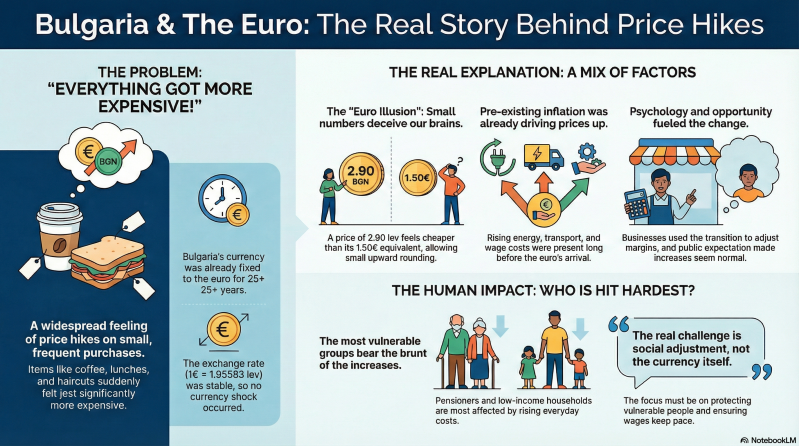
Prices Rose in Bulgaria After the Euro’s Introduction in 2026. But What Are We Actually Seeing?
When Bulgaria joined the eurozone on January 1, 2026, the moment was met with a mix of pride, relief, and anxiety. Pride in finally becoming fully integrated into the economic core of the European Union. Relief after decades of waiting. And anxiety—because almost everyone had heard the same warning before:
“Everything gets more expensive when the euro arrives.”
Now, only weeks after the changeover, the same sentence can be heard everywhere. In cafés in Sofia. In grocery stores in Plovdiv. In small shops in Bansko.
Prices have gone up. Full stop.
But the real question is bigger than that.
Is the euro making Bulgaria more expensive—or are we witnessing something else entirely?
A Shared Feeling, Almost Everywhere
What strikes you first is that the price increases are not just visible in statistics. They are felt.
Coffee no longer costs “two leva and something.”
Lunch is no longer an obvious everyday choice.
Small services—haircuts, taxis, quick purchases—have become noticeably more expensive.
This is not a uniquely Bulgarian experience. The same story was told in:
-
Italy
-
Spain
-
Germany
-
Slovenia
-
Croatia
Whenever the euro is introduced, something happens to people’s relationship with prices.

Bulgaria Already Had the Euro—Just Not by Name
The paradox is that Bulgaria did not really change currency in the traditional sense.
The lev had been pegged to the euro for more than 25 years.
The exchange rate was fixed and unchanged:
1 euro = 1.95583 lev
There was no classic currency shock. No devaluation. No sudden loss of purchasing power on paper.
And yet—something still happened.
The Euro Illusion: When Numbers Deceive Us
Here we arrive at one of the most thoroughly studied phenomena in eurozone history:
the euro illusion.
When prices move from a “large” number to a “small” one, several things occur:
-
2.90 lev feels cheap
-
1.50 euro suddenly feels… not exactly cheap, but not expensive either
-
The brain stops calculating precisely
-
Small upward roundings quietly slip in
A precise conversion gives:
2.90 lev = 1.48 euro
But in reality, it becomes:
1.50 euro
Two cents.
Trivial?
No—percentage-wise it is a clear increase, and multiplied across hundreds of thousands of daily purchases, it becomes a systematic rise in everyday costs.
It is almost always small, frequent purchases that are affected first:
-
coffee
-
pastries
-
lunches
-
quick services
When Everything Is Being Changed Anyway, Margins Get Adjusted
There is also a very human, almost mundane explanation.
When businesses already have to:
-
replace price tags
-
print new menus
-
update cash systems
-
change signage
…some take the opportunity to adjust margins.
Not out of malice.
Not as part of a conspiracy.
But because this is the moment when it can be done without anyone clearly remembering where the old line was.
This is precisely why Bulgaria introduced:
-
a long period of dual price display
-
consumer protection monitoring
-
mechanisms for reporting unjustified increases
And still, complaints poured in—by the thousands.
But Not Everything Can Be Blamed on the Euro
Here the analysis must remain honest.
Prices in Bulgaria were already rising before the euro changeover.
Inflation in 2024–2025 was real:
-
higher energy and raw material costs
-
more expensive transportation
-
rising wages
-
stronger domestic consumption
The euro did not arrive in a vacuum.
It landed in an economy that was already heating up.
That is why it is misleading to say:
“This is the euro’s fault.”
It is more accurate to say:
“The euro became the visible turning point where ongoing trends suddenly became obvious.”
Services Always Move First
One pattern repeats itself in almost every eurozone country:
Services become more expensive faster than goods.
Why?
-
They are harder to compare
-
They are consumed locally
-
They are governed more by perception than by exact calculation
You can compare the price of a liter of milk.
You cannot easily compare the price of a haircut.
This is why the service sector often leads price increases after a currency change.
Psychology: When Everyone Expects Prices to Rise
Economics is not just numbers.
It is also expectations.
When:
-
media report that prices will increase
-
people talk about it
-
social media amplifies the narrative
…both sellers and buyers begin acting as if it has already happened.
Sellers raise prices “just to be safe.”
Customers accept slightly higher prices because they expected them anyway.
This is not fraud—it is collective psychology.
Part of a Larger Transition
What Bulgaria is experiencing now is not just a euro phenomenon.
It is a structural transition.
Bulgaria is no longer:
-
a “cheap EU country”
-
an exception
-
an economic periphery
The country is moving—slowly but clearly—toward:
-
higher price levels
-
higher wages
-
higher expectations
For some, this transition is painful.
For others, it is necessary.
Who Is Hit the Hardest?
Not tourists.
Not digital nomads.
Not those earning in euros.
The hardest hit are:
-
pensioners
-
low-income households
-
people without indexed wages
For them, every “small” increase matters.
This is the real challenge after euro adoption:
social adjustment, not the currency itself.
So What Is the Conclusion?
Yes—prices have risen in Bulgaria after the euro’s introduction in 2026.
That is true.
But:
-
it is not a dramatic currency shock
-
it is not a uniquely Bulgarian failure
-
it is not solely the euro’s fault
It is:
-
inflation plus rounding plus psychology
-
an economy outgrowing its old role
-
a country leaving behind the label of Europe’s cheap backyard
The Real Question Going Forward
The question is not whether prices increased.
The question is:
what Bulgaria does next.
-
Are the most vulnerable protected?
-
Do wages follow price levels?
-
Is euro stability used for long-term development?
-
Or are the gains absorbed by short-term price hikes?
The euro itself is only a tool.
What determines the future is how the country chooses to use it.
And right there—right there—the next chapter begins.

By Chris...