On a cold January morning in 2026, the news from Minnesota barely stood out at first.
Another shooting. Another police cordon. Another familiar sequence of headlines scrolling past screens in cafés in Berlin, Stockholm, Sofia and Tokyo. For many outside the United States, it landed with a weary shrug: again.
But this time, something felt different.
Not the scale.
Not the numbers.
Not even the location.
It was the context.
The United States — once the world’s most confident exporter of certainty — now appears unsure of itself. And when uncertainty takes root in a superpower, it does not stay within its borders.
The Mirror That Arrived Too Early
That same week, the film Civil War was being discussed across the United States. A fictional portrayal of a country torn apart by internal conflict. No clear ideology. No simple villains. A president clinging to power. Armed groups controlling parts of the country. Journalists moving through a fragmented landscape, trying to document what remains.
Director Alex Garland deliberately refused to explain why the fictional war began.
“We all know why it could happen,” he said.
That statement resonated far beyond America’s borders. Because it was not only about the United States. It was about a pattern the world recognizes.
History does not announce itself with sirens. It hums quietly in the background — until suddenly everyone hears it at once.

The Illusion of Sudden Collapse
From the outside, societies often appear to fall apart overnight. Revolutions. Civil wars. State failure.
From the inside, they unravel slowly.
The United States is not on the brink of a classic civil war. Tanks are not rolling through Washington. States have not formally broken away. The military is not divided along political lines. Elections still take place.
But something fundamental has weakened: a shared reality.
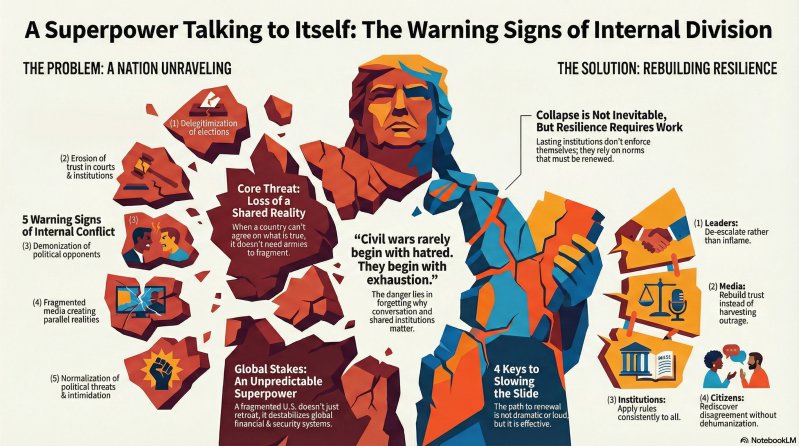
When a country can no longer agree on what is true, it does not need armies to fragment. The fragmentation happens mentally first.
Minnesota Is Not the Story
The shootings in Minnesota were tragic. But they are not the story.
They are symptoms.
For decades, America treated mass shootings as isolated failures: mental health issues, policing problems, gun laws, local breakdowns. Those debates continue. But beneath the surface lies something deeper — something international observers often see more clearly than Americans themselves.
Violence has become interpretable.
Every act is immediately filtered through ideology. Who committed it matters less than what it can be used to prove. Tragedy becomes evidence. Grief becomes ammunition.
When violence is no longer universally condemned but selectively justified, a line has been crossed — quietly.
How Civil Wars Actually Begin
Civil wars do not begin because people disagree. They begin when people stop believing disagreement can be resolved without force.
There are warning signs that political scientists, historians and diplomats recognize instantly:
-
Delegitimization of elections
-
Erosion of trust in courts and institutions
-
Demonization of political opponents as existential threats
-
Fragmented media and parallel realities
-
Normalization of threats and political intimidation
Today, the United States checks more of these boxes than at any point in modern history.
This does not mean collapse is inevitable. But it does mean that the shock absorbers that once buffered the system have thinned.
A Country Talking Past Itself
Travel through today’s United States — physically or digitally — and you encounter parallel nations occupying the same geography.
Different facts.
Different heroes.
Different enemies.
Different versions of history.
People no longer argue to persuade. They argue to signal loyalty. Conversations are no longer bridges — they are border checkpoints.
This is where Civil War gets it right. Not through weapons or spectacle, but through emotional accuracy.
The film understands something many political analyses miss: breakdown begins when curiosity disappears.
Extremism Is Not Loud — It Is Narrow
The filmmakers insist the movie is not a prophecy but a warning against extremism.
That distinction matters.
Extremism is not defined by volume or ideology. It is defined by the inability to live with ambiguity, compromise and coexistence.
The most dangerous societies are not the angriest ones. They are the ones that lose their capacity for doubt.
In today’s United States, doubt is treated as weakness. Moderation as betrayal. Nuance as cowardice.
This is not uniquely American. But America amplified it — and now reflects it back to the world.
Journalism in the Crossfire
One of the film’s central figures is a war photographer. A witness, not a warrior.
This is no coincidence.
In societies sliding toward internal conflict, journalists become targets long before soldiers do. Because controlling the narrative becomes more important than controlling territory.
When media is dismissed wholesale as “the enemy of the people,” “propaganda,” or “corrupt,” truth becomes optional. And when truth becomes optional, power fills the vacuum.
Internationally, this alarms America’s allies more than any single election outcome.
Democracies survive not through perfection, but through trusted mechanisms of correction.
The Global Stakes
Why should the rest of the world care?
Because the United States is not just a country. It is infrastructure.
Financial systems.
Security guarantees.
Diplomatic frameworks.
Cultural signals.
When America destabilizes internally, global systems wobble externally. Markets react. Alliances hesitate. Rivals test boundaries.
A fragmented United States does not simply retreat. It becomes unpredictable.
And unpredictability in a nuclear-armed superpower is not a domestic issue.
The Myth of Immunity
Americans often believe their institutions are too strong to fail. Europeans once believed the same. So did the British Empire. And Rome.
No system collapses because it is weak. It collapses because it assumes strength is permanent.
The U.S. Constitution is a remarkable document. But it was designed for a society that trusted its processes. Laws do not enforce themselves. Norms do.
And norms, once repeatedly broken, do not magically regenerate.
What Actually Slows the Slide
The most important truth is this: nothing is predetermined.
The United States still possesses immense resilience. Civic engagement. Independent courts. A professional military. A deeply rooted constitutional culture.
But resilience is not passive. It requires renewal.
That renewal will not come from louder rhetoric or harsher laws. It will come from:
– Leaders who de-escalate rather than inflame
– Media that rebuilds trust instead of harvesting outrage
– Institutions that apply rules consistently
– Citizens who rediscover disagreement without dehumanization
None of this is dramatic. None of it trends on social media. All of it works.
When Fiction Becomes Uncomfortable
Civil War unsettles because it refuses to reassure.
It does not explain itself. It does not comfort the audience with clear moral binaries. It simply asks: What happens if the guardrails quietly disappear?
That question now hangs over the United States — and, by extension, the world.
Not because violence is inevitable.
But because complacency is.
A Final Thought
Civil wars rarely begin with hatred. They begin with exhaustion.
With people who no longer believe conversation matters.
With institutions that stop being defended because they feel distant.
With citizens who retreat into certainty because uncertainty has become unbearable.
On January 26, 2026, the United States is not at war with itself.
But it is dangerously close to forgetting why it should not be.
And history is unforgiving toward nations that stop remembering that in time.

By Chris...