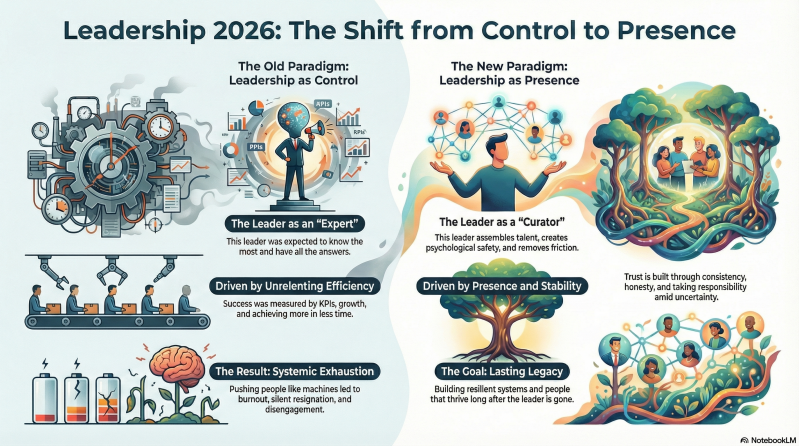
In 2026, leadership is no longer a title. Nor is it a role you step into through a corner office, an organizational chart, or a LinkedIn headline. Leadership has become something far more exposed – and at the same time far more demanding. It is no longer about knowing the most, but about understanding the most. Not about controlling people, but about holding together systems where people, technology, and pace would otherwise tear everything apart.
We are living in a moment where old leadership models no longer work, while new ones are still forming. This creates a vacuum. And in a vacuum, either fear arises – or opportunity.

After Efficiency Comes Exhaustion
For decades, leadership has been rewarded for efficiency, growth, and optimization. More in less time. More KPIs, more dashboards, more meetings about meetings. But by 2026, the consequences are impossible to ignore. People are tired. Organizations are tired. Leaders are tired.
This is not laziness. It is not a lack of ambition. It is systemic exhaustion.
Leaders who still try to “push through” change are met with passive resistance, silent resignation, or outright departure – often mentally long before it becomes formal. Modern leadership therefore no longer begins in strategy documents, but with a simple realization: people are not machines – and organizations are not spreadsheets.
AI Does Not Change Leadership – It Exposes It
AI has not replaced leaders in 2026. What it has done is expose those who were never truly leading in the first place.
When decision support, analysis, forecasting, and content production can be done faster and more accurately by machines, what remains is what cannot be automated: judgment, timing, ethics, human understanding. The core of leadership has become visible – and therefore uncomfortable.
Leaders who once hid behind processes, titles, and hierarchies now stand exposed. At the same time, those who understand the whole, who can read the room and navigate complexity, gain a massive advantage.
Leadership in 2026 requires systems thinking, not micromanagement. The ability to see relationships between people, technology, culture, and direction – rather than optimizing isolated parts.
From Expert to Curator
The traditional ideal was the leader as expert: the one who knows the most, answers the fastest, decides with authority. That ideal is gone.
The leader of 2026 is closer to a curator than an expert. Someone who:
-
assembles the right competencies
-
creates psychological safety
-
removes friction
-
holds direction when the map is missing
It is no longer about having all the answers, but about asking the right questions. Not about dominating the room, but about enabling conversations where others dare to contribute.
In practice, this means that many senior leaders – those who have carried projects, crises, and people for decades – are suddenly more relevant than ever. Experience has once again become a strategic asset.
The Generational Shift That Was Never About Age
Much has been said about generational conflict. Boomers versus Gen Z. Experience versus innovation. But by 2026, it becomes clear that the conflict was never about age – it was about the meaning of work.
Younger generations refuse meaningless processes. Older ones see straight through them. That unites them. The real divide lies between:
-
those who protect the system
-
and those who want it to actually work
Future leaders understand this and build bridges. They create environments where experience and curiosity do not compete – they complement each other.
Presence Beats Charisma
Charismatic leadership loses its power in 2026. Big words, visionary slides, and inspirational keynote phrases no longer suffice. People have seen too much, heard too much, and been promised too much.
What builds trust instead is presence:
-
leaders who are consistent
-
who say “I don’t know”
-
who stay when things get hard
-
who take responsibility even when it costs
It is quiet. Undramatic. And incredibly powerful.
Leading in Uncertainty – Without a Map
2026 is a year without a manual. Economic shifts, geopolitical instability, technological acceleration, and social fragmentation are happening simultaneously. There are no ready-made models that cover it all.
Modern leadership accepts this. It does not pretend to be in control – but takes responsibility anyway.
This means:
-
making decisions with incomplete information
-
communicating direction without false certainty
-
creating stability through relationships, not rules
Leaders who wait for perfect data will always be too late.
Ethics Becomes Strategy
Ethics used to live in value statements. In 2026, ethics are business-critical. AI decisions, data collection, automation, and optimization create consequences far beyond what can be measured.
Leaders who fail to understand the human cost of technical decisions quickly lose legitimacy.
Modern leadership therefore asks questions like:
-
Should we – not just can we?
-
Who is affected when no one is watching?
-
What happens to the human being inside the system?
Leadership 2026 – Part II: Beyond Performance, After Achievement
There is a quiet shift happening beneath the surface of leadership in 2026. It rarely makes headlines. It does not fit neatly into keynote slides or quarterly reports. Yet it may be the most important transformation of all: leadership is moving beyond performance.
For decades, leadership has been measured by outcomes. Growth curves, market share, delivery speed, productivity. Leaders were defined by what they achieved and how fast they got there. But something fundamental changes once achievement is no longer the primary driver. Once goals are reached. Once titles lose their shine. Once ambition is no longer fueled by fear of falling behind.
What emerges then is a different kind of leadership. Slower. Deeper. Less visible – but far more stabilizing.
The Post-Achievement Leader
In 2026, more leaders find themselves in unfamiliar territory. They have already proven themselves. They have built, scaled, delivered, survived crises. They are no longer driven by external validation. And that creates a question many organizations are unprepared for:
What happens when a leader no longer needs to prove anything?
This is not decline. It is transition.
The post-achievement leader is not focused on climbing. They are focused on holding. Holding context. Holding people. Holding direction when momentum alone is no longer enough.
These leaders are often misread. They do not chase visibility. They speak less, but with precision. They ask uncomfortable questions instead of offering instant solutions. In systems addicted to speed, they may even be seen as slow. In reality, they are operating on a different layer of time.
From Momentum to Meaning
Performance leadership thrives on momentum. Targets create motion. Deadlines create urgency. Competition creates energy. But momentum is finite. When organizations rely on it exclusively, exhaustion is inevitable.
Leadership beyond performance asks a different question: not how fast can we move, but why are we moving at all?
In 2026, employees are no longer motivated by abstract growth narratives. They want coherence. Direction that makes sense. Work that connects effort to meaning.
This requires leaders who can articulate purpose without turning it into marketing language. Leaders who understand that meaning cannot be imposed – it must be cultivated.
Meaning emerges when people feel:
-
seen rather than used
-
trusted rather than monitored
-
part of something real rather than performative
This is not soft leadership. It is structurally demanding. It requires restraint, patience, and the ability to resist the constant pressure to “do more.”
Leadership Without the Mask
Earlier leadership eras rewarded certainty. Even when leaders did not know, they were expected to appear as if they did. Confidence mattered more than accuracy.
In 2026, this mask no longer holds.
Complexity has grown too large. Change moves too fast. AI has made it obvious that certainty can be simulated – but wisdom cannot.
Leaders who drop the mask gain credibility. Saying “I don’t know yet” is no longer a weakness; it is a signal of honesty. What matters is not having immediate answers, but being willing to stay present while answers emerge.
This form of leadership is psychologically demanding. It requires leaders to tolerate ambiguity without rushing to closure. To stay with tension without forcing premature decisions. Many cannot.
But those who can become anchors in unstable systems.
The Quiet Power of Experience
For years, experience was treated as a liability. Too slow. Too expensive. Too resistant to change. But 2026 marks a revaluation.
In environments shaped by AI, automation, and constant disruption, experience becomes a form of pattern recognition. Not nostalgia. Not habit. But the ability to sense when something feels familiar beneath the surface – even when the technology is new.
Experienced leaders see:
-
when a “new” idea is actually an old mistake in new packaging
-
when enthusiasm masks structural weakness
-
when speed hides lack of direction
They are not opposed to innovation. They are opposed to repeating avoidable failures.
Organizations that sideline this form of intelligence lose more than individuals. They lose memory. And without memory, systems repeat themselves endlessly.
Leadership as Stewardship
Beyond performance, leadership becomes stewardship.
Stewardship is not about ownership. It is about responsibility across time. Caring not only about results today, but consequences tomorrow. About what remains after you leave.
Steward leaders ask:
-
What kind of organization are we building people inside, not just products outside?
-
What habits are we normalizing?
-
What behaviors are being rewarded quietly, not officially?
This perspective shifts leadership from extraction to cultivation. From short-term wins to long-term resilience.
In 2026, resilience is not built through motivational speeches. It is built through consistency. Through leaders who do not panic, overreact, or disappear when pressure increases.
The Leader as System Regulator
Modern organizations behave like nervous systems under constant stimulation. Notifications, metrics, alerts, updates. Everything signals urgency.
Leadership beyond performance acts as a regulator.
Not by suppressing information – but by filtering it. Deciding what matters now, what can wait, and what is simply noise. This is one of the most underrated leadership skills of 2026: attention management.
When leaders are reactive, organizations become anxious. When leaders are grounded, systems stabilize.
Calm is contagious. So is panic.
Letting Others Step Forward
Perhaps the most radical shift in post-achievement leadership is the willingness to step back.
Not to disappear – but to create space.
Leaders beyond performance are less concerned with being central. They are more interested in developing others’ judgment, not dependency. They tolerate others making decisions differently than they would. They allow learning to include mistakes.
This is difficult for leaders who built their identity on being indispensable.
But organizations that survive the next decade will not be built around heroes. They will be built around distributed capability.
The Final Paradox
Leadership in 2026 comes with a paradox:
The less leaders need power, the more trustworthy they become.
The less they seek recognition, the more influence they hold.
The less they perform leadership, the more they actually lead.
Beyond performance, leadership becomes less visible – but more real.
It is not louder. It is steadier.
Not faster. But more durable.
And in a world that feels increasingly unstable, that may be the most valuable form of leadership left.
Leadership 2026 – Part III: Legacy, What Remains When You Are Gone
There is a moment every leader eventually faces, whether consciously or not. A moment when the question is no longer what am I building, but what will remain once I step away?
In 2026, this question is no longer philosophical. It is practical.
Organizations are changing faster than leaders rotate. Technologies evolve quicker than strategies. People come and go. In this reality, leadership measured only by short-term results becomes fragile. What matters increasingly is not the leader’s presence – but the absence.
What still works when you are not in the room?
Legacy Is Not Reputation
Legacy leadership is often misunderstood. It is not about personal branding, memoirs, awards, or being remembered fondly. Reputation is how people talk about you. Legacy is how systems behave after you leave.
A leader’s true legacy shows up in moments like:
-
how decisions are made when authority is absent
-
how people treat each other under pressure
-
whether principles hold when shortcuts are tempting
In 2026, legacy is less about what leaders say, and more about what they quietly normalize.
Culture Is the Only Durable Strategy
Strategies expire. Business models age. Technologies are replaced. Culture endures.
Leadership as legacy understands that culture is not created through slogans, but through repeated behavior. Through what is tolerated, rewarded, ignored, or quietly discouraged.
People learn the real rules quickly:
-
Who gets promoted – and why
-
Who gets protected – and who doesn’t
-
What happens when someone speaks up
Legacy leaders are acutely aware that every exception becomes a signal. Every compromise teaches the organization something – often more than any formal policy.
Building Leaders, Not Followers
One of the clearest markers of legacy leadership is succession without collapse.
Leaders who build followers create dependency. Leaders who build leaders create continuity.
In 2026, organizations that rely on a few central figures are increasingly vulnerable. Illness, burnout, conflict, or sudden change can destabilize entire systems. Legacy-oriented leaders therefore invest not in loyalty, but in judgment.
They ask:
-
Can people think for themselves here?
-
Do they understand why, not just what?
-
Are they trusted to decide without permission?
This form of leadership requires humility. It means accepting that others will lead differently. Sometimes better. Sometimes worse. But always in their own way.
Letting Go Without Disappearing
Legacy leadership is not about abrupt exits or dramatic handovers. It is about gradual redistribution of responsibility.
The most effective leaders in 2026 know how to step back without abandoning. They remain available without hovering. They advise without controlling.
This balance is rare – and difficult.
Too much presence suffocates. Too little creates vacuum. Legacy leadership lives in between: a steady reduction of dependency and a steady increase in trust.
Time as a Leadership Dimension
Short-term leadership optimizes for now. Legacy leadership thinks in layers of time.
What decisions today will:
-
simplify life for those who come after?
-
reduce future risk rather than postpone it?
-
preserve human dignity under future pressure?
This perspective often clashes with quarterly logic. But in 2026, organizations that ignore long-term consequences pay later – socially, financially, reputationally.
Legacy leaders are willing to absorb short-term discomfort to prevent long-term damage.
Ethics as Inheritance
Every organization inherits ethical patterns from its leaders. Not through codes of conduct, but through lived behavior.
In times of crisis, people default to what they have seen modeled before. That is why ethical leadership is never abstract. It is rehearsal for future stress.
Legacy leadership asks:
-
What ethical reflexes are we training here?
-
What shortcuts are being silently justified?
-
What lines are truly non-negotiable?
When leaders cut corners “just this once,” they teach others to do the same – often without the same judgment.
The Final Test of Leadership
In the end, leadership legacy is measured quietly.
It shows when:
-
conflicts are handled without escalation
-
power is transferred without chaos
-
people stay not because they must, but because they want to
The paradox of leadership in 2026 is this:
The strongest leaders are those whose absence does not create fear – but confidence.
They leave behind systems that can think, decide, and adapt without them. Cultures that do not collapse under pressure. People who are stronger, not smaller, because of their leadership.
That is not control.
That is not performance.
That is legacy.

By Chris...