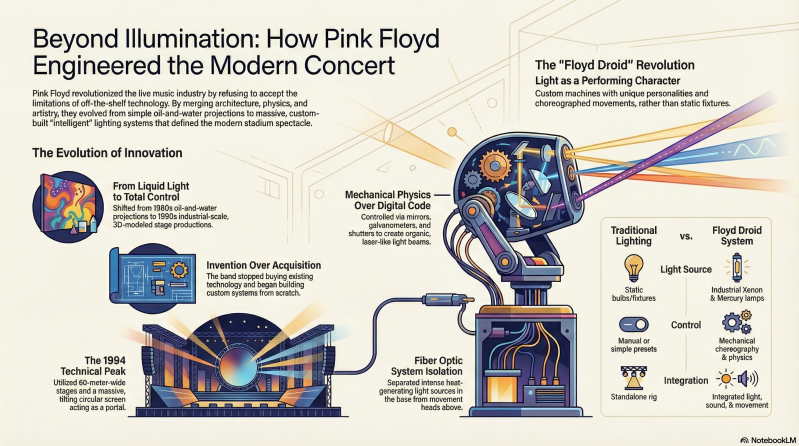
There are bands that play music, and then there are bands that reshape the space around them. Pink Floyd belonged to the latter. For them, light was never a supporting element. It was not there to reveal the musicians or decorate the stage. It was atmosphere, tension, architecture and emotion at once. It was a language in its own right.
When the available tools could not express what they imagined, they did not compromise. They did not scale down their ideas. Instead, they chose a far more demanding path. They built their own systems from scratch, changing not only how concerts looked, but how they were experienced.

From Liquid Chaos to Visual Control
In the late 1960s, long before stadiums and large-scale productions, Pink Floyd stood in small London clubs surrounded by liquid light projections. Oil and water moved between glass plates, forming patterns that were never the same twice. Colors merged and dissolved, creating a constant sense of transformation that mirrored the music.
The visuals were not controlled in any strict sense, but they were immersive. The audience was not simply watching a performance. They were inside it, surrounded by shifting forms that blurred the line between sound and image. Even at this early stage, something fundamental had already taken shape. Light was not there to support the music. It was part of the experience itself.
When the Stage Stopped Being a Stage
As the band moved into the 1970s, their ambitions expanded dramatically. The stage was no longer seen as a platform but as an environment that could be shaped and transformed. Large projections stretched across space, inflatable objects floated above the audience, and entire structures were constructed during performances.
During The Wall, this idea reached an extreme. A physical barrier was built between the band and the audience, brick by brick, until the performers were completely hidden. The stage itself became a narrative device.
But as these environments grew more complex, a limitation became clear. The lighting technology of the time was not capable of keeping up. Traditional fixtures could illuminate surfaces, but they could not create space. They could not produce beams that felt present, nor could they move with intention.
Rather than accept this limitation, Pink Floyd chose to move beyond it.
The Moment Light Became Alive
Out of this need came one of the most remarkable innovations in live production: the Floyd Droids. These machines did not resemble conventional lighting fixtures. They appeared as mechanical entities rising from the stage, scanning their surroundings with movements that felt almost deliberate.
When they activated, the atmosphere shifted. The audience did not just see light; they felt it. There was a sense of interaction, as if the machines themselves were aware of the space they occupied. This marked a turning point where light stopped being a tool and became a presence.
The System Behind the Illusion
The brilliance of the Floyd Droids lay in their design. Instead of combining everything into a single unit, the system was divided. The powerful light source, based on industrial short-arc technology, remained in the base. This was where the intensity and heat were generated.
From there, the light was transported through fiber optics to a head positioned high above. This allowed the visible part of the system to move freely without carrying the weight or heat of the source. The result was a level of agility and intensity that had never been seen before.
The beams that emerged were neither soft nor thin. They occupied space in a way that felt almost physical. In a haze-filled environment, they became structures rather than effects.
Before Software, There Was Mechanics
At a time when digital control systems were still developing, these machines relied entirely on mechanical solutions. Movement was created through motors and hydraulics, direction was controlled by galvanometers, and color was achieved by physically shifting filters into the light path.
Everything was tangible. There was no software smoothing out motion or correcting imperfections. Instead, the system carried its own variations, its own irregularities, which gave it character. It did not feel programmed. It felt alive.
When Light Took the Stage
During performances, the Floyd Droids became more than part of the visual design. They acted. They moved with intention and timing, creating moments where the light itself carried the narrative.
There were sequences where the band stepped back and the light took over completely, sweeping across the audience and transforming the space without the need for sound. Each unit behaved in its own way, contributing to a larger composition that extended beyond music.
In those moments, the role of lighting changed fundamentally. It was no longer a supporting element. It was a performer.
Why It Didn’t Survive—And Why That Matters
Despite their innovation, systems like the Floyd Droids did not become standard. They were complex, demanding and difficult to maintain. They required a level of engineering and precision that made them impractical for widespread use.
As the industry evolved, more accessible technologies emerged. Lighting became standardized, self-contained and easier to control. The focus shifted toward efficiency and scalability.
But something was lost in that transition. The willingness to experiment beyond existing systems became less common. The industry moved forward, but also became more predictable.
Visionaries Who Thought Beyond Light
Behind these developments were individuals who approached the stage from a completely different perspective. Lighting designer Marc Brickman treated light as a way to shape space, while stage architect Mark Fisher envisioned entire environments rather than static structures.
Their collaboration led to productions where every element was connected. Light, movement, structure and image were no longer separate disciplines. They became parts of a single system designed to immerse the audience fully.
The Peak of Integration
By the 1990s, these ideas had reached a new level. Productions became fully integrated environments where nothing existed in isolation. The stage could move, transform and reshape itself, while light and image worked together seamlessly.
The circular screen became a defining element, capable of altering perception and drawing the audience into the performance. Light was no longer directional. It was immersive, surrounding the audience and turning the entire space into part of the experience.
What They Really Changed
It is easy to focus on the technical aspects of what Pink Floyd achieved, but that misses the deeper point. Their true impact was not in the machines themselves, but in the way they approached creation.
They demonstrated that when existing tools are not enough, the solution is not compromise. The solution is invention. Technology becomes a result of vision, not a limitation of it.
From Then to Now
Today, the tools available are far more advanced. LED systems, digital control and real-time programming allow for a level of precision and flexibility that was unimaginable decades ago.
Yet the essential challenge remains the same. Technology alone does not create experience. It requires a vision strong enough to push beyond what already exists.
Pink Floyd worked in a space where imagination exceeded capability. That gap forced them to build something new.
Light as Life
Standing in a modern arena, watching beams move through space, it feels natural. But it was not always this way. At one point, it had to be imagined, tested and built from nothing.
Pink Floyd transformed light into something that could carry emotion, tension and narrative. They turned machines into presence and engineering into storytelling.
Their legacy is not only what they created, but how they thought. The understanding that if something does not yet exist, the answer is not to wait.
The answer is to build it.

By Chris...
Few musical artists have left such an impressive legacy on the design of concert tours as Pink Floyd. Three of the band’s founding members met while studying architecture at Regent Street Polytechnic, making it perhaps inevitable that they would seek to push the envelope in terms of their stage designs. ----LINK HERE-----
Pink Floyd - Pulse Tour Stage Building | Exclusive Archive Footage | Oslo, Norway - August 1994
Pink Floyd - A Momentary Lapse of Reason Tour Backstage Preparations