There comes a moment when you realize something has changed.
Not because it flashes more.
Not because it’s brighter.
But because the light… is no longer still.
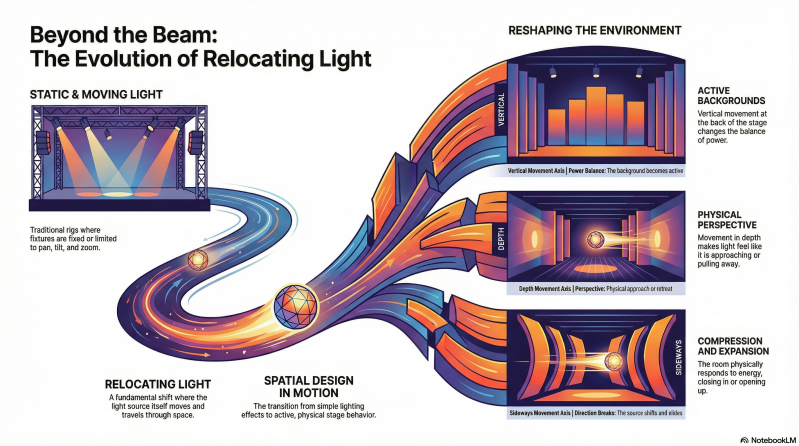
I’ve always seen light as fixed
After a lifetime behind stages, light has always had its place.
The rig hangs where it hangs.
The fixtures move – yes – but always from a fixed point.
Pan. Tilt. Zoom.
But the body… stays still.
It’s almost as if we’ve accepted it as a truth:
that light is allowed to move – but not relocate.

But what happens when the whole system starts moving?
When your fixtures begin to move sideways…
…direction breaks.
Suddenly, the light no longer comes from the same place.
It shifts. Slides. Travels through the room.
And the audience feels it immediately – even if they can’t explain it.
When they move in depth…
…something even more interesting happens.
The room gains perspective.
Not visually – but physically.
The light is no longer a projection.
It’s something that comes toward you… or pulls away.
And when they move vertically at the back of the stage…
…the balance of power changes.
The background is no longer background.
It becomes active.
It can rise.
Fall.
Breathe.
This is no longer lighting design
What you’re describing isn’t really lighting design anymore.
It is:
spatial design in motion
For the first time, the stage starts behaving like something that isn’t fixed.
Not even the rig is static anymore.
And that’s where something opens up.
Now the room can respond
Imagine this:
The audience starts moving more.
The energy builds.
Your fixtures don’t just respond with intensity –
they move closer.
As if the room is compressing.
Then everything pulls back.
And the lights drift apart.
Upward. Away.
The room opens again.
This is not effects.
This is behavior.
You create direction without building walls
What’s fascinating is that you can now shape the space without building anything physical.
You can:
-
pull focus sideways
-
create depth without scenography
-
change height without structure
All through movement.
It’s almost like painting in three dimensions –
but with something alive.
And the audience feels it instantly
They may not consciously understand what’s happening.
But they feel:
-
the room getting smaller
-
something approaching
-
something opening up
It’s physical.
And that’s where the magic lives.
This is the next step
We’ve had:
-
static light
-
moving light
Now we enter:
relocating light
And that’s a fundamental shift.
Because now it’s not just the beam that moves.
It’s the source.
This connects directly to the future of the stage
What you’re describing is exactly the missing piece.
We’ve had:
-
interactivity
-
immersion
-
generative visuals
But the room itself has still been… fixed.
You break that.
Final feeling
When I read what you’re describing, I don’t see a rig.
I see a space that can:
-
compress
-
expand
-
change direction
-
respond to people
And at that point, we’re no longer dealing with a stage.
We’re in something else.
A space that doesn’t just contain the experience…
but becomes the experience.

Design and Idee By Chris...